 Voxly Vision















Does this apply to me?
Why it applies to UK advertisers. The AI Act follows the audience, not the advertiser. Article 2 brings in businesses outside the EU when the output of their AI is used in the EU, so a UK brand's AI-generated ad that is shown to people in Ireland, France or anywhere else in the EU must meet Article 50. Social feeds, programmatic display, influencer posts and YouTube pre-roll rarely stop at the UK border, and geo-fencing is hard to guarantee, which is why many UK brands and agencies are treating EU-standard AI labels as their default. Leaving the EU doesn't take UK brands out of scope; selling or advertising into it puts them back in.
Article 50 applies to anyone who creates or publishes AI-generated content seen in the EU. For marketing and communications that means:
- Brands and advertisers who decide that AI is used in a campaign and sign off the final creative. Under the AI Act they are "deployers", even if an agency did the production work.
- Agencies and production studios that choose and run the AI tools day to day. Brand and agency can both be deployers, so the duty can be shared.
- Influencer and creator content made with AI tools, including fully synthetic influencers and brand avatars promoting products.
- Brands running AI chatbots or voice assistants in customer service, sales or conversational ads, where people must be told they're talking to AI.
- UK and other non-EU brands whose ads are placed in, or can foreseeably reach, EU audiences, including through the open web and social platforms.
It is enforced by national market surveillance authorities in each EU country, with the European Commission's AI Office overseeing general-purpose AI models. The UK has no equivalent labelling law yet, but the CAP Code's rules on misleading advertising still apply to AI content shown to UK audiences, so a realistic AI ad can need an EU label and still breach UK rules if it misleads.
Key rules
The parts of Article 50 that matter for advertising and communications:
- Label deep fakes. If AI generates or alters an image, video or audio that resembles real people, objects, places or events and could pass as authentic, you must disclose that it's AI-made (Article 50(4)). This covers realistic products, places and avatars, not just famous faces.
- Make the label clear and timely. Disclosures must be clear and distinguishable and given at the latest when someone first sees or hears the content (Article 50(5)). Hidden metadata or a platform's own tag isn't enough on its own.
- Disclose AI text on matters of public interest. AI-written text published to inform the public, which can include health, safety, environmental or financial claims, must be disclosed unless a person has reviewed it and someone takes editorial responsibility.
- Tell people when they're talking to AI. Chatbots and voice assistants must make it clear they are AI unless that's obvious (Article 50(1)).
- Mark AI output. Providers of generative AI tools must mark output so it's machine-readable and detectable (Article 50(2)). Tools already on the market before 2 August 2026 have until 2 December 2026.
- Creative work gets a lighter touch, ads rarely do. Evidently artistic, satirical or fictional work only needs a disclosure that doesn't spoil it, but the Commission's guidance says commercial content will rarely qualify.
Common breaches
Article 50 is new, so these are the patterns most likely to catch brands out:
- Synthetic people with no label — AI models, presenters or "customers" in an ad who look like real people.
- AI influencers and brand avatars promoting products without saying they're AI-generated.
- Cloned or synthetic voices in video, radio or podcast ads with no spoken or on-screen disclosure.
- Product shots that look better than reality — AI renders that make a product bigger, shinier or more capable than it is. These also risk breaching misleading advertising rules.
- Labels in the wrong place — buried in a caption, shown only at the end of a video, or left to the platform's auto-tag.
- Leaning on the creative exception for content that is really an ad.
How Voxly Vision checks an ad against this code
Coming soon: Article 50 checks are in development. This example shows how Voxly Vision flags a creator post that isn't labelled as an ad; the AI check will work the same way, flagging realistic AI-generated people, voices and scenes with no clear AI label before the ad goes live.
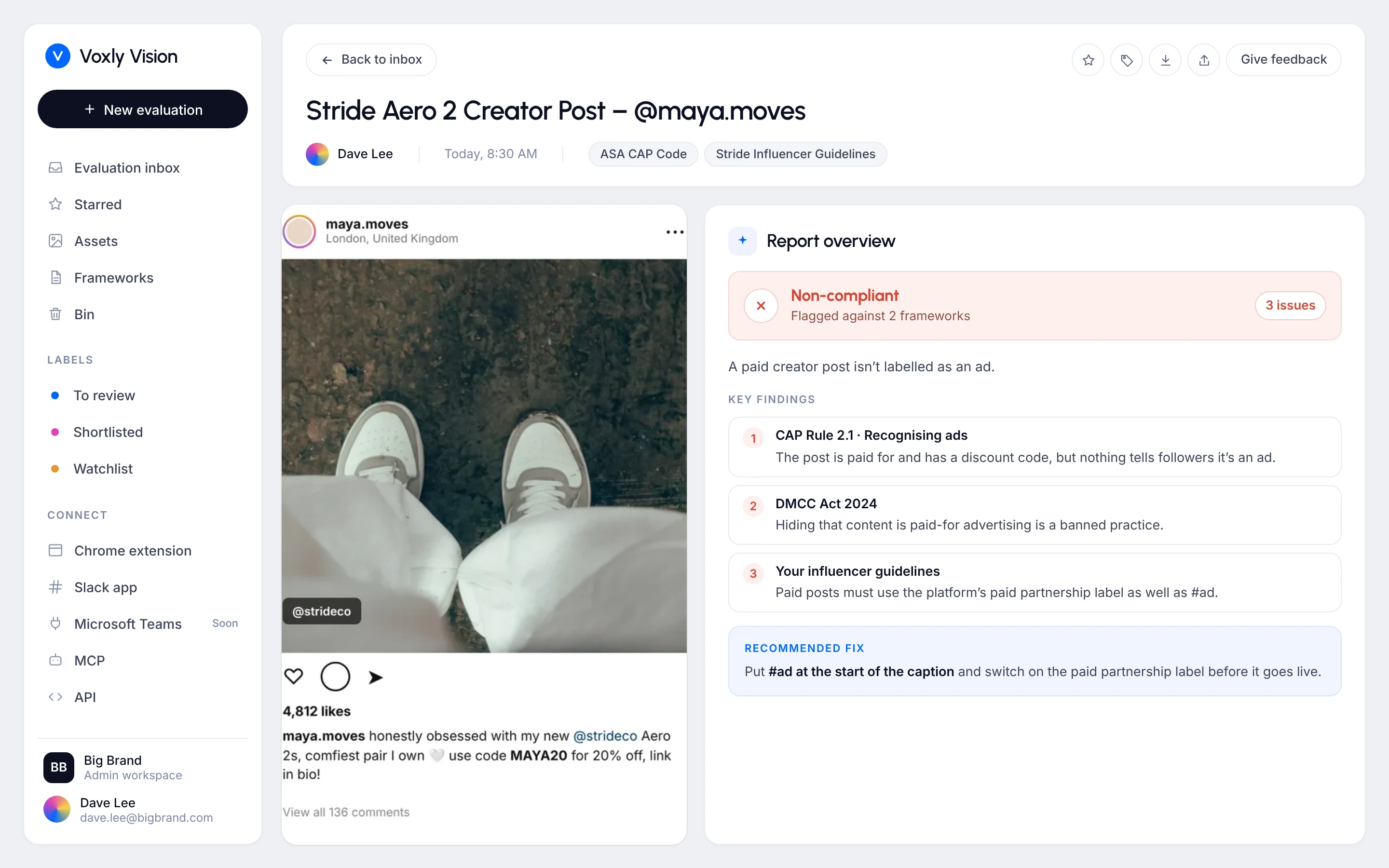
Recent rulings
No national regulator has published an Article 50 decision yet. These are the documents that set how the rules are applied:
Commission guidelines on Article 50
Published · 20 Jul 2026
Explains when AI content counts as a deep fake, uses advertising examples such as synthetic influencers and enhanced product images, and says commercial content will rarely benefit from the creative exception.
Code of Practice on marking and labelling AI-generated content
Published · 10 Jun 2026
A voluntary code with an optional EU "AI" icon for labels, guidance on where labels should sit, and spoken disclaimers for audio-only ads. It is likely to become the main reference point for showing compliance.
Frequently asked questions
Can Voxly Vision check my ads against Article 50 today?
Not yet. Article 50 checks are coming soon. Talk to us about early access →
Does Article 50 apply to UK brands?
Yes, if your AI-generated content is shown to people in the EU. Where the ad is seen matters, not where the brand is based.
Does every AI-assisted ad need a label?
No. The duty applies when AI content looks real and could be mistaken for authentic. Colour correction, AI backgrounds that don't mislead and obviously fantastical scenes generally don't need one.
Who is responsible, the brand or the agency?
Often both. The deployer is whoever decides how the AI is used, so a brand that signs off the creative and an agency that runs the tools can share the duty. Agree who labels what in your contracts.
Is a platform's "AI-generated" tag enough?
Not on its own. The advertiser still has to make sure a clear disclosure appears when people first see the content.
What are the fines?
Up to €15 million or 3% of worldwide annual turnover, whichever is higher.