 Voxly Vision























Do AI-generated ads need to be labelled in the UK?
Not by law, yet. The UK has no rule that says every AI-made ad must carry a label. The ASA's position, restated in its June 2026 guidance on AI content and deepfakes, is that the existing rules apply in full, however an ad is created.
That has real consequences. If AI is used to show a product doing something it can't, such as smoother skin, a fuller plate or a bigger room, the ad is misleading under the CAP Code. A label won't fix that. And if the ad leaves people thinking a real person endorsed the product when they didn't, it breaks the rules whether or not it says "AI".
What the EU AI Act requires
If an ad can be seen in the EU, Article 50 of the EU AI Act applies, wherever the brand is based. Since 2 August 2026:
- Realistic AI content must be labelled. Images, video or audio that look like real people, products, places or events, and could pass as authentic, must be disclosed as AI-made.
- The label must be clear and timely, shown at the latest when someone first sees or hears the content. Hidden metadata isn't enough on its own.
- Chatbots and voice assistants must tell people they're talking to AI.
Fines reach €15m or 3% of global turnover. Social, programmatic and influencer campaigns rarely stop at the UK border, so many UK brands now treat an EU-standard label as their default.
Does this apply to me?
Yes, if you or your agency use AI to create or edit any part of an ad: product shots, models, voiceovers, backgrounds, copy or video. The advertiser stays responsible for the result. The ASA has ruled against brands whose ads were made or placed by automated tools, and said that automation doesn't shift accountability.
Where AI ads go wrong
- Exaggerated results. AI-enhanced before-and-after images, food that looks better than the real thing, or cosmetics effects the product can't deliver.
- Deepfakes of real people. AI likenesses of celebrities or experts implying an endorsement that doesn't exist.
- Harmful or offensive output. AI tools can produce sexualised or stereotyped images, and the advertiser is responsible for what's published.
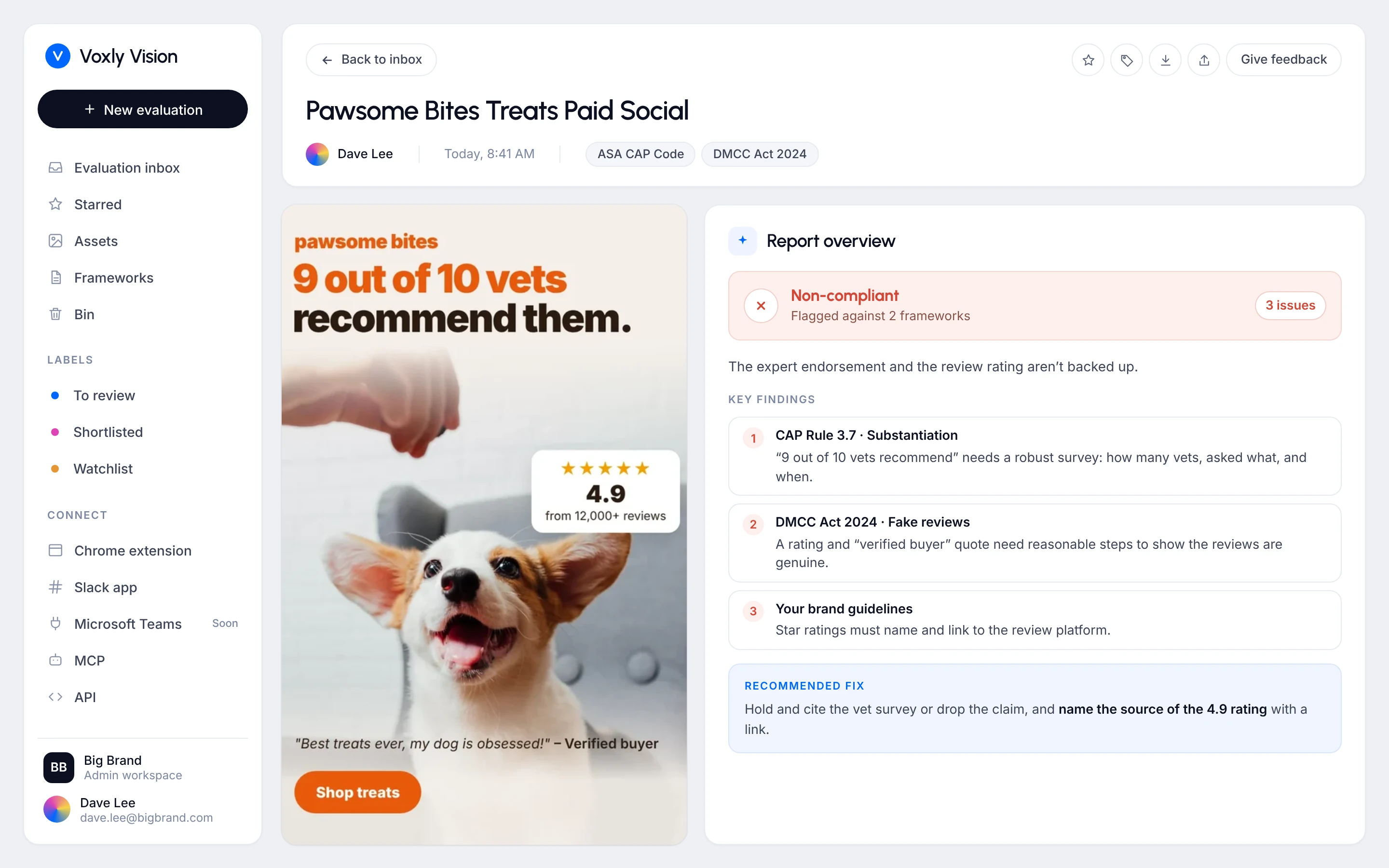
- Fake testimonials. AI-generated "customers" or reviews presented as real, which also breaches the fake reviews rules in the DMCC Act.
How Voxly Vision checks an AI-made ad
Voxly Vision flags realistic people, voices and scenes that may need an AI label for EU audiences, and checks the ad's claims and imagery against the UK rules at the same time.
Recent rulings and enforcement
ASA guidance on AI content and deepfakes
Published · Jun 2026
The ASA confirmed that existing rules apply in full to AI-made ads, that AI depictions of real people must not imply a genuine endorsement, and that advertisers are responsible for biased or harmful output from AI tools.
Cosmos
Upheld · Apr 2025
An ad for an AI video app, shown in a mobile game, generated a kissing video featuring a real singer. The ASA found it harmful and likely to cause serious offence.
Stripe & Stare
Upheld · Dec 2022
A nightwear brand's ad was made using Google's automated ad tools. The ASA found it socially irresponsible and held the brand, not the tool, responsible for the ad.
Frequently asked questions
Are AI-generated ads legal in the UK?
Yes. There is no ban on using AI to make ads. They must follow the same rules as any other ad: not misleading, not harmful and not offensive.
Do AI-generated ads need to be labelled in the UK?
There is no UK legal requirement to label AI-generated ads. A label may still be needed to stop an ad misleading people, for example where realistic AI imagery could be mistaken for a real result.
Do AI ads need to be labelled in the EU?
Yes, where the content is realistic and could pass as authentic. Article 50 of the EU AI Act has applied since 2 August 2026 and covers ads seen in the EU, including those from UK brands.
Can I use AI to make a celebrity appear in my ad?
Not without their permission. An AI likeness that implies an endorsement the person hasn't given breaches the CAP Code, and may also raise legal claims outside the ASA's remit.
Who is responsible if an AI tool produces a non-compliant ad?
The advertiser. The ASA has made clear that using automated or AI tools doesn't move responsibility away from the brand.