 Voxly Vision

























Are fake reviews illegal in the UK?
Yes. The DMCC Act 2024 lists fake reviews among the commercial practices that are always unfair, whatever the circumstances. It is banned to:
- Write, commission or publish fake reviews, or pay someone else to do it
- Publish reviews that hide the fact they were incentivised, for example with free products, discounts or payment
- Present reviews in a misleading way, such as hiding negative ones or mixing reviews for different products
- Publish reviews without taking reasonable steps to stop fake or misleading ones appearing
The last point catches retailers and platforms as well as brands. If your site shows customer reviews, you need a process to prevent and remove fake ones.
What is drip pricing?
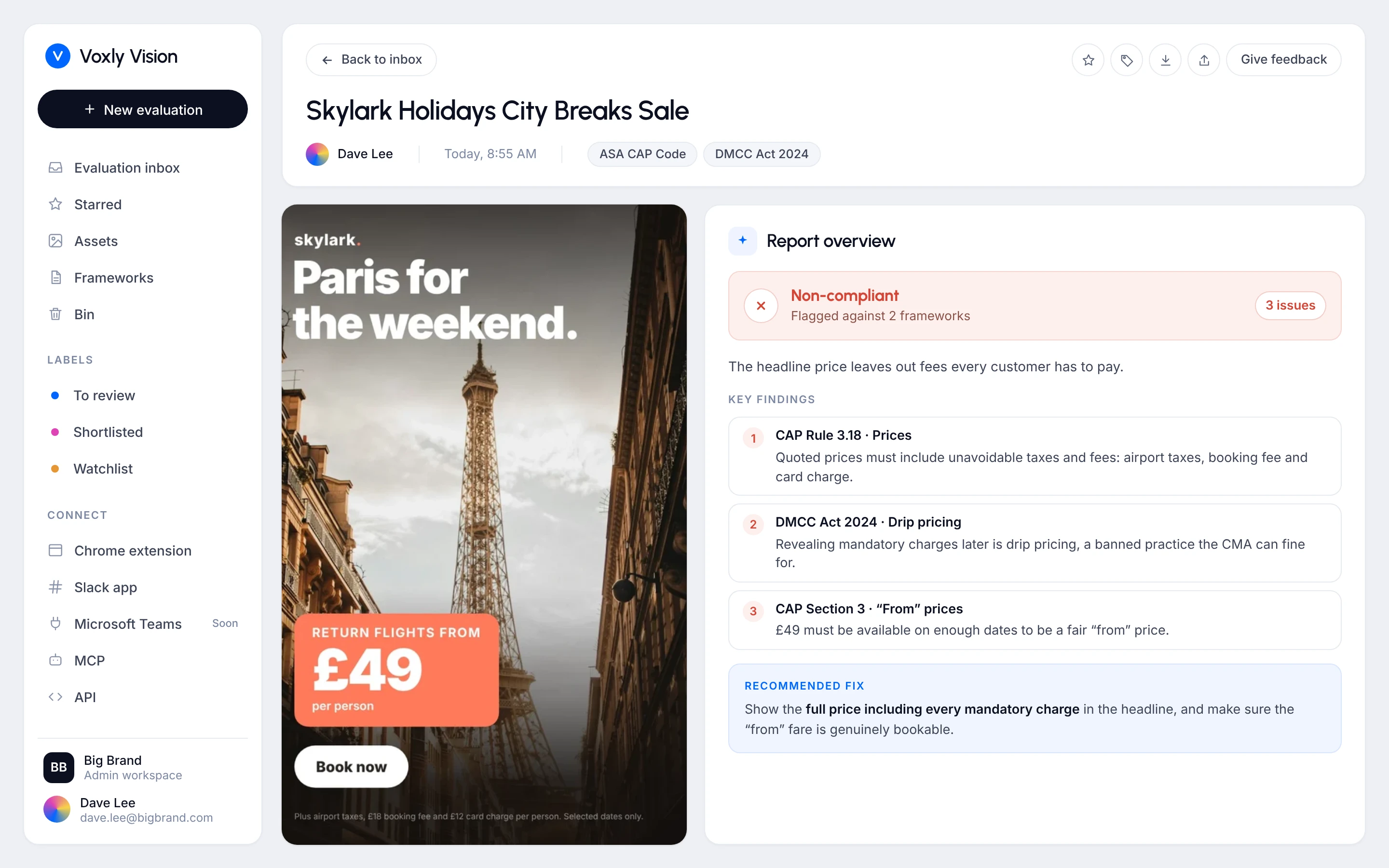
Drip pricing is showing a low headline price and adding unavoidable fees later in the buying journey: booking fees, service charges, admin fees or compulsory delivery. Under the DMCC Act the headline price must include every fee the customer can't avoid.
Optional extras can still be added later, as long as they are genuinely optional. Where a fee can't be worked out in advance, such as delivery to an unknown address, you must say that it will be added and how it is calculated.
The rules apply in ads too. A social post, poster or search ad that quotes a price must quote the full price, not a teaser that grows at checkout. The ASA applies the same principle under the CAP Code.
Does this apply to me?
Almost certainly. The rules apply to any business selling to UK consumers, in any sector. The CMA's first year of enforcement covered driving schools, ticket resellers, gyms, airlines, appliance retailers, food delivery and review platforms.
The CMA can investigate, decide and fine directly, up to 10% of global turnover, and order refunds to customers. Trading Standards can also take action, and the ASA can require misleading ads to be withdrawn.
Other pressure-selling tactics to avoid
The same law covers the tactics that often sit alongside fake reviews and hidden fees:
- False urgency. Countdown timers that reset, or "only 2 left" claims that aren't true.
- Fake reference prices. "Was £99, now £49" when the product was never genuinely sold at £99.
- Pre-ticked extras. Opting customers into add-ons they didn't choose.
- Subscription traps. Making it hard to cancel, or failing to explain auto-renewal. New subscription rules are expected in 2027.
How Voxly Vision checks an ad's pricing
Voxly Vision reads the price in your ad, flags headline prices that leave out compulsory fees, unclear "from" prices and urgency claims, and shows which rule is at stake.
Recent rulings and enforcement
Marks Electrical
Fined £720,000 · Jun 2026
Customers buying appliances were automatically opted in to extra paid services. The CMA also secured around £600,000 in refunds for about 40,000 customers.
AA Driving School and BSM
Fined £4.2m · Apr 2026
A compulsory £3 booking fee was left out of the headline lesson price shown to around 80,000 learners. This was the CMA's first fine under its new powers, plus more than £760,000 in refunds.
Rules breached: DMCC Act, drip pricing
Autotrader, Feefo, Dignity, Just Eat and Pasta Evangelists
Investigations opened · Mar 2026
The CMA opened formal investigations into how these businesses collect, check and display customer reviews, after sending warning letters to 54 businesses in 2025.
Frequently asked questions
Are fake reviews illegal in the UK?
Yes. Since 6 April 2025 the DMCC Act has banned commissioning, writing or publishing fake reviews, hiding that reviews were incentivised, and publishing reviews without reasonable steps to stop fake ones.
Can I offer customers an incentive to leave a review?
Only if the incentive is not conditional on the review being positive and the reviews are clearly marked as incentivised. Hiding the incentive is banned.
Is drip pricing illegal?
Yes. The headline price must include every compulsory fee. Adding unavoidable charges later in the buying journey is a misleading practice under the DMCC Act.
Do I have to include delivery in the headline price?
If delivery can be calculated in advance and the customer can't avoid it, it should be included. If it can't be calculated in advance, say clearly that delivery will be added and how it is worked out.
How much can the CMA fine a business?
Up to 10% of global annual turnover, imposed directly without going to court. It can also order refunds to affected customers.
Do these rules apply to small businesses?
Yes. The rules apply to every business selling to UK consumers. The CMA's enforcement so far has focused on larger firms, but warning letters have gone to over 150 businesses.