 Voxly Vision


























Does this apply to me?
Yes, if your business makes any environmental claim to UK consumers: in ads, on packaging, on your website, in product names or in labels and logos. It also applies to business-to-business claims that end up in front of consumers.
In January 2026 the CMA published supply chain guidance making clear that retailers can be liable for passing on a supplier's misleading claim. Brands, manufacturers and retailers all need evidence and checks.
The code sits alongside the CAP Code, which the ASA uses to judge environmental claims in ads. For a practical overview of both, see green claims and greenwashing.
The six principles
Every environmental claim must:
- Be truthful and accurate. The product or business must live up to the claim.
- Be clear and unambiguous. The meaning that consumers take from the claim must match the evidence.
- Not omit or hide important relevant information. Don't highlight a green feature while leaving out a bigger environmental impact.
- Only make fair and meaningful comparisons. Compare like with like, using the same basis.
- Consider the full life cycle of the product or service, from raw materials to disposal.
- Be substantiated. Hold robust, credible and up-to-date evidence before making the claim.
Common breaches
- Vague words such as "eco", "green", "sustainable" and "conscious" with no explanation.
- Partial claims presented as whole ones, such as "recycled" when only part of the product is.
- Own-brand eco logos that look like independent certifications.
- Carbon neutral and net zero claims that rely on offsetting without saying so.
- Comparisons with an unstated or outdated baseline.
How Voxly Vision checks an ad against this code
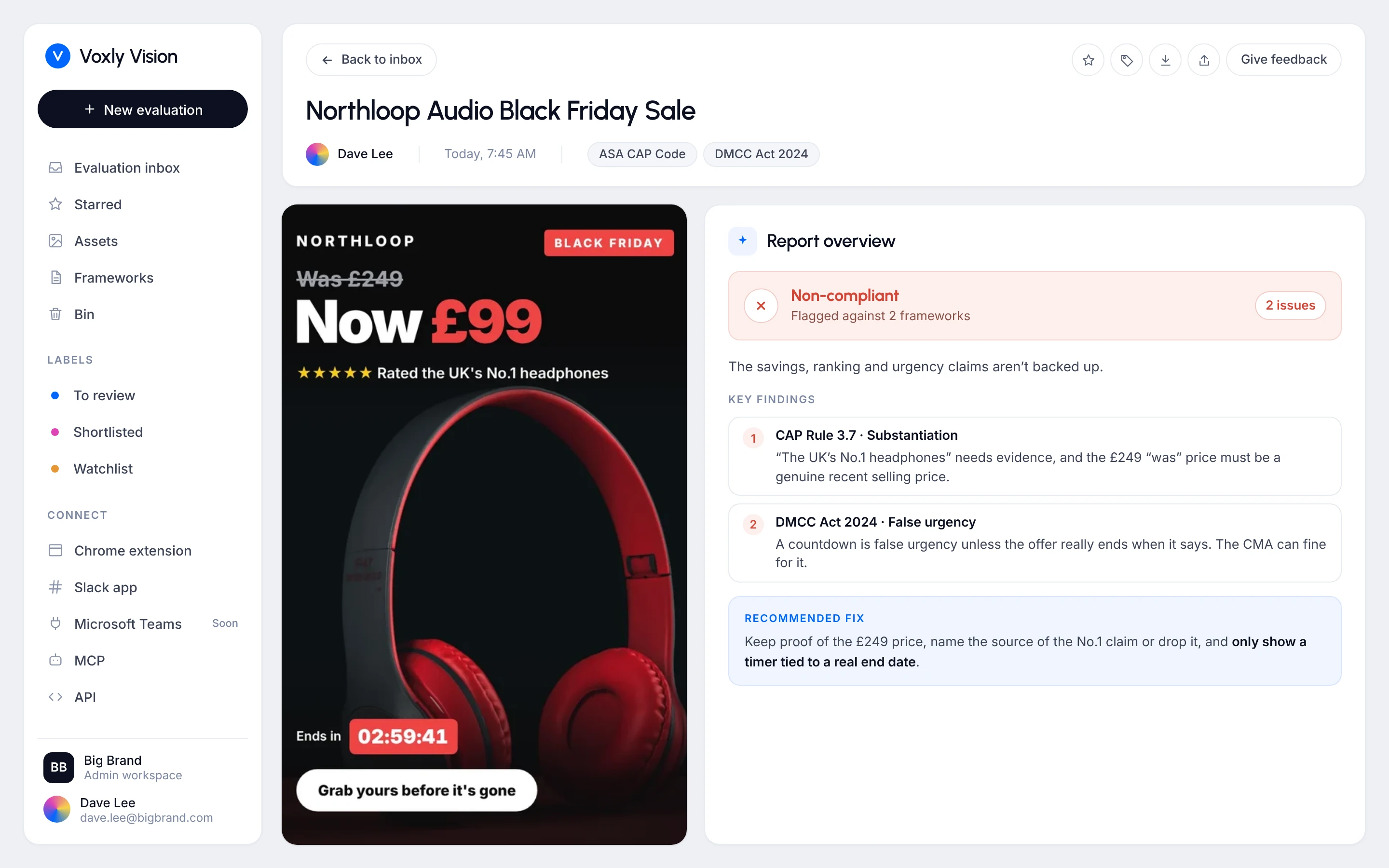
Voxly Vision flags environmental words, imagery and badges, checks whether the claim is qualified in the ad itself, and shows which principle is at stake.
Recent rulings and enforcement
Making green claims across the supply chain
CMA guidance · Jan 2026
Retailers can be liable for stocking products with misleading green claims. The CMA expects businesses to keep evidence, run spot checks and get supplier declarations, and may focus on whoever is best placed to fix the problem.
ASOS, Boohoo and George at Asda
Undertakings · Mar 2024
After a CMA investigation into fashion green claims, the three retailers formally committed to make sure their environmental claims are accurate and clear, and to stop using vague terms without explanation.
Frequently asked questions
Is the Green Claims Code law?
No, the code is guidance. But it explains how existing consumer law, now in the DMCC Act 2024, applies to environmental claims. Breaking those principles can mean breaking the law.
What are the six principles of the Green Claims Code?
Claims must be truthful and accurate, clear and unambiguous, not omit important information, make fair comparisons, consider the full life cycle, and be substantiated.
What happens if I break the Green Claims Code?
The CMA can investigate and, since April 2025, fine businesses up to 10% of global turnover under the DMCC Act. The ASA can also rule against ads under the CAP Code.
Does the Green Claims Code apply to packaging?
Yes. It covers environmental claims anywhere consumers see them, including packaging, labels, product names and websites.