 Voxly Vision


























What counts as a green claim?
A green claim is anything in an ad that suggests a product, service, process or brand is better for the environment. That includes the obvious words, like sustainable, eco-friendly, recycled, carbon neutral and net zero. It also includes the less obvious signals:
- Green leaves, globes, trees and nature imagery that imply an environmental benefit
- Brand or range names such as "Conscious" or "Eco"
- Logos, badges and labels that look like certifications
- Comparisons, such as "50% less plastic"
The ASA judges a claim by how an ordinary consumer would understand the whole ad, not by what the advertiser meant.
Does this apply to me?
Yes, if your ads say or suggest anything about the environment. Green claims are not limited to one industry. Recent ASA rulings have covered fashion retailers, airlines, energy companies, banks, carpet makers, food and drink brands and car manufacturers.
Two regulators share the work. The ASA enforces the CAP Code, which covers the ad itself. The CMA enforces consumer law, including the DMCC Act 2024, which covers misleading claims anywhere in the customer journey, including packaging, product pages and labels. Since April 2025 the CMA can fine firms directly, without going to court.
The six principles of the Green Claims Code
The CMA's Green Claims Code sets out what the law already requires. Your green claims must:
- Be truthful and accurate. The product must live up to the claim.
- Be clear and unambiguous. Vague terms like "eco-friendly" or "green" need a clear basis, or they will be read as an absolute claim.
- Not omit or hide important information. Don't highlight one green feature while leaving out a bigger environmental impact.
- Make fair and meaningful comparisons. Compare like with like, and say what you are comparing against.
- Consider the full life cycle of the product or service, not just one stage of it.
- Be substantiated. Hold robust, up-to-date evidence before the claim goes out.
In January 2026 the CMA added supply chain guidance: retailers can be liable for repeating a supplier's misleading green claim, so everyone in the chain needs evidence and checks.
What the ASA looks for
CAP Code section 11 covers environmental claims. In practice, most upheld rulings come down to four mistakes:
- Absolute claims without absolute evidence. "Sustainable" or "recycled" will be read as applying to the whole product or range unless the ad says otherwise.
- Missing qualifications. If only part of a product is recycled, say how much, and say it in the ad itself, not just on a linked page.
- Carbon neutral and net zero claims that rely on offsetting without explaining it, or that leave out the brand's overall emissions.
- Selective focus. Ads that highlight green investments while leaving out a business that is mostly high-carbon, as in the ASA's rulings against airlines, energy firms and banks.
Space-limited formats are no excuse. The ASA has rejected arguments about character limits in short-form ads. If the qualification doesn't fit, the claim shouldn't be made.
How Voxly Vision checks an ad for green claims
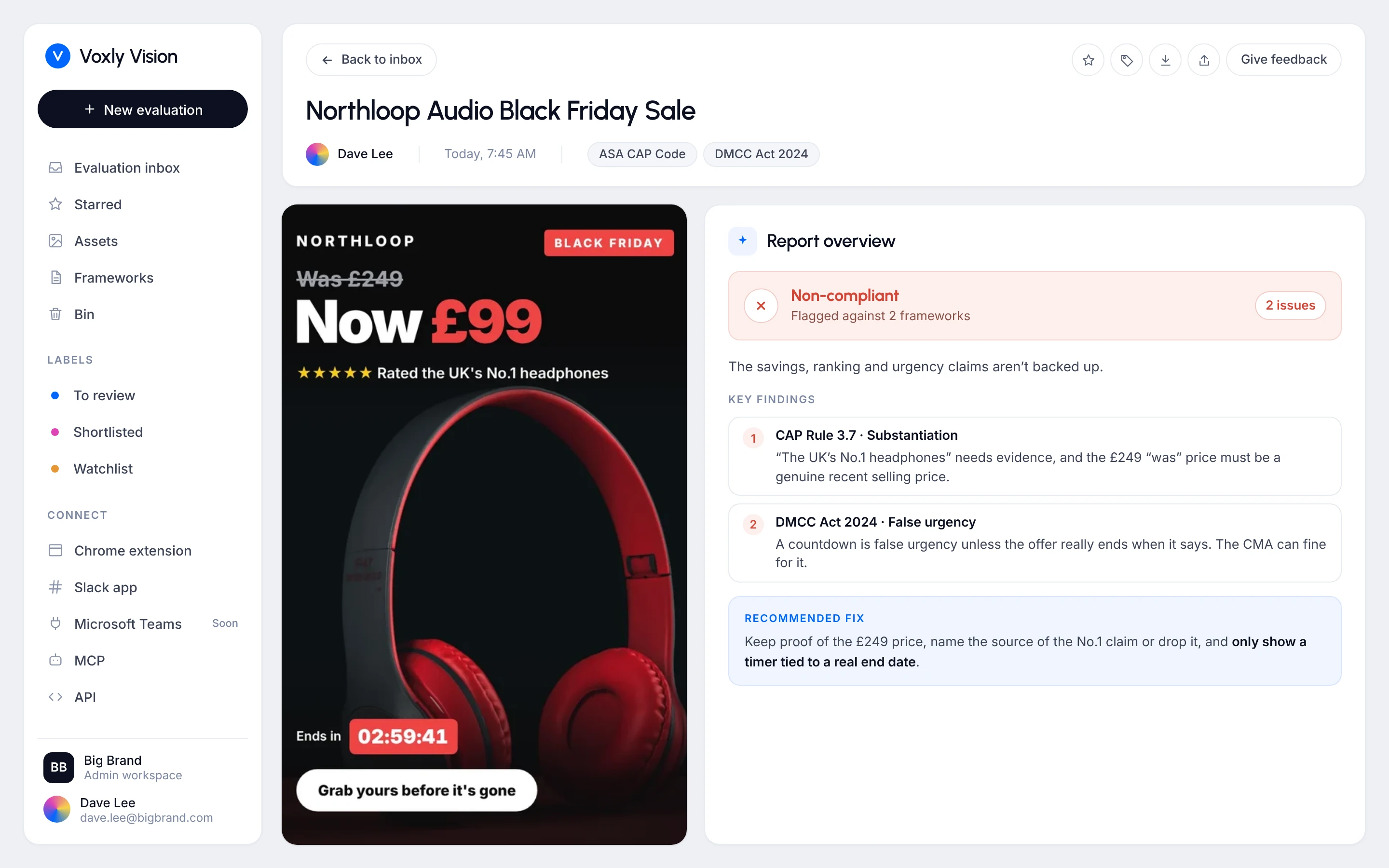
Voxly Vision flags absolute environmental words, nature imagery and badges that imply a benefit, checks for qualifications in the ad itself, and tells your team which rule applies and how to fix the claim.
Recent rulings and enforcement
Adidas, Calvin Klein and UNIQLO
Upheld · 2026
Ads promoting "Recycled Running Shoes", "Responsibly sourced collections" and "Recycled Materials" were read as meaning every product was made entirely from recycled or preferred materials. None of the brands held evidence for that.
Rules breached: CAP Code 3.1, 3.3, 3.7, 11.1, 11.3
Nike, Lacoste and Superdry
Upheld · 3 Dec 2025
Ads described products as "sustainable" without explaining what that meant. Nike argued that character limits left no room to qualify the claim. The ASA rejected that: if the claim can't be qualified, it shouldn't be made.
CMA supply chain guidance
Published · Jan 2026
The CMA's guidance on making green claims across the supply chain says retailers can be liable for stocking products with misleading green claims, and expects brands to keep evidence, run spot checks and get supplier declarations.
Frequently asked questions
What is greenwashing?
Greenwashing is making a product, service or company look better for the environment than it really is, through misleading words, images, labels or comparisons. In the UK it can breach both the CAP Code and consumer law.
Is greenwashing illegal in the UK?
Yes. Misleading environmental claims breach consumer protection law, now set out in the DMCC Act 2024, and the CAP Code for advertising. The CMA can fine firms up to 10% of global turnover, and the ASA can require ads to be withdrawn.
What is the Green Claims Code?
Guidance published by the CMA in 2021 that explains how consumer law applies to environmental claims. It has six principles: claims must be truthful, clear, complete, fair in comparisons, consider the full life cycle and be substantiated.
Can I call my product sustainable?
Only if you can prove it applies to the whole product across its life cycle, which is very hard. In most cases it is safer to make a specific, qualified claim, such as the percentage of recycled content, and back it up with evidence.
Are carbon neutral claims allowed?
They can be, but the ASA expects you to explain whether the claim relies on offsetting, and to hold evidence for it. Unqualified carbon neutral and net zero claims are a frequent reason for upheld rulings.
Who enforces green claims in the UK?
The ASA enforces the CAP Code for advertising. The CMA enforces consumer law across the whole customer journey, including packaging and websites. The FCA has its own anti-greenwashing rule for financial firms.